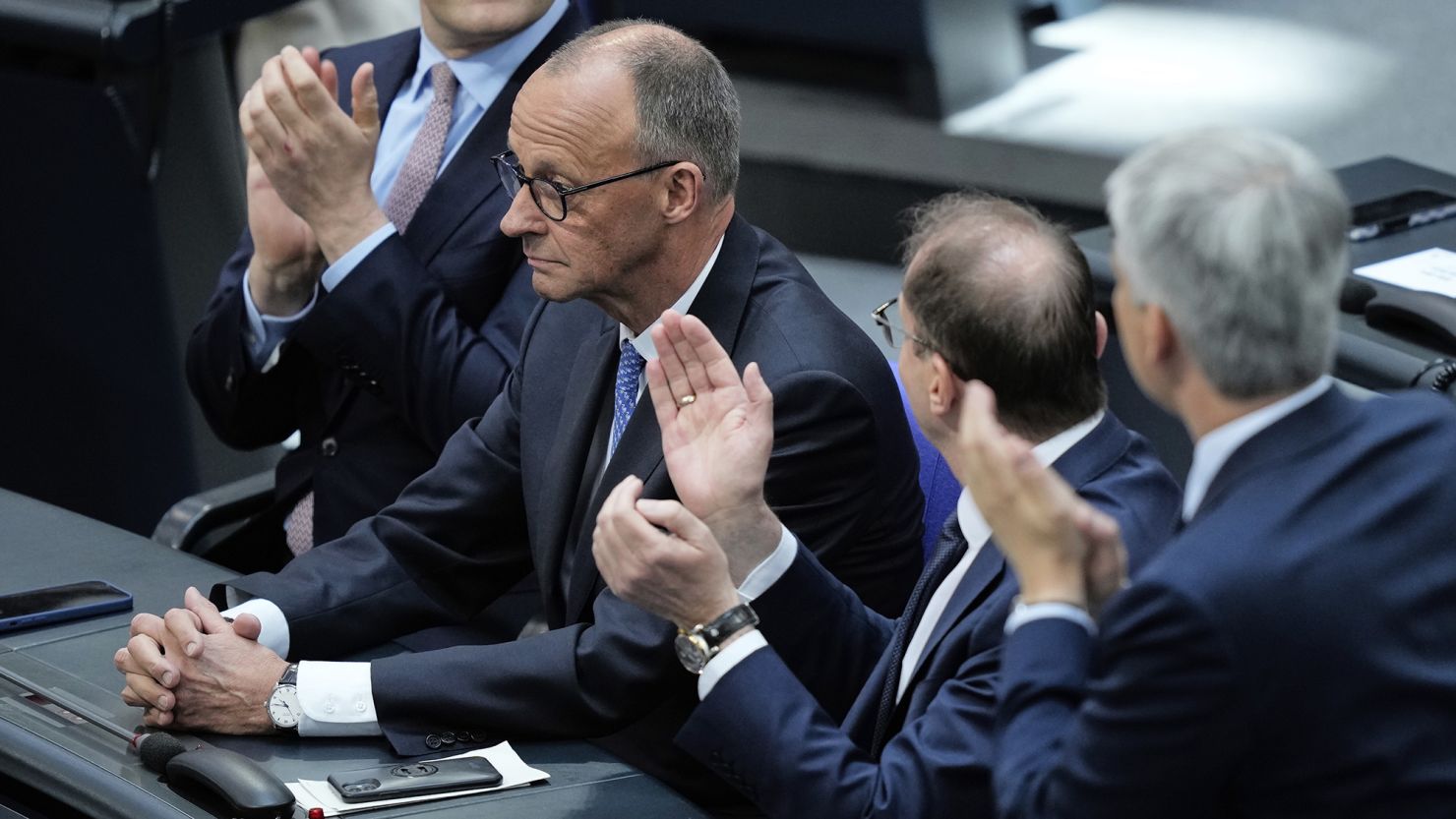
“Perhaps we didn’t make it clear quickly enough after the change of government that we couldn’t accomplish this enormous reform effort overnight,” Merz told his Christian Democratic Union (CDU), adding: “I accept this criticism”.
But, rallying delegates at the national congress in the southern city of Stuttgart, he vowed that he “did not want to be dragged down by pessimism, fatalism and intellectual laziness … It’s a waste of time.”
“I want to motivate us to peak performance,” he said, pledging to boost innovation and rebuild infrastructure and the military. “Germany must reach its highest level, otherwise we won’t achieve what we have set out to do.”
Among the high-profile guests at the party congress for the first time in years was his predecessor and long-time party rival Angela Merkel.
Merz, 70, has made it his mission to steer their CDU back to its conservative roots and undo the more liberal legacy of Merkel, especially her welcome to more than a million migrants a decade ago.
But the party congress comes as Merz faces pressure over a limping economy, poor personal approval ratings and the sustained threat of the far-right Alternative for Germany (AfD) ahead of several regional elections.
A barometer of the party’s mood at the national congress will be whether Merz gets re-elected as party chief with the customary result of around 90 percent.
– Global splash, trouble at home –
Merz, after his party’s February 2025 election win, took office last May at the helm of a coalition with the centre-left Social Democrats (SPD) of ex-chancellor Olaf Scholz.
At the time, Merz boldly vowed to revitalise the stagnating economy, limit irregular migration, rearm Germany to deter Russia, and strengthen Germany’s role in the world.
On the global stage, Merz has indeed made a splash, taking a lead role on supporting Ukraine, stepping up NATO defence spending and maintaining dialogue with volatile US President Donald Trump.
“We stand with the Ukrainian people without any ifs or buts,” Merz stressed Friday.
But on the home front, the score card has been more mixed as his plans for boosting Europe’s biggest economy were slowed by Trump’s tariff blitz and other hurdles.
With GDP growth forecast at a meagre one per cent this year, the captains of Germany Inc have harshly attacked the leader of Germany’s pro-business party.
Rainer Dulger, head of business group BDA, called on Merz this week to present “a genuine reform programme” with tax and social welfare cuts and less bureaucracy.
Merz has faced headwinds from surveys that have often given the AfD a lead over the CDU/CSU coalition of his party and its Bavarian sister the Christian Social Union.
Another poll shocker came this week when Merz was deemed less popular than Scholz — whose bland leadership style Merz had mercilessly mocked while in opposition — in an INSA survey for Bild daily.
Many in the CDU are also upset for a host of other reasons.
Merz, a longtime proponent of fiscal discipline, broke a campaign promise of no new debt before even taking office in order to finance a spending splurge on defence and infrastructure.
“I am well aware that this opening up of new debt was a tough pill to swallow for many, including here in this room,” said Merz. “It was for me too. This decision was perhaps the hardest I’ve had to make in the last 12 months.”
Merz has also turned off many voters with often blunt comments, recently questioning whether Germans — with their many sick days — still deserve their reputation as hard workers.
“We cannot maintain prosperity with a four-day week and work-life balance,” he has told them.
Uwe Jun of Trier University told AFP that Merz — a millionaire hobby pilot — “still struggles when it comes to public likability”.
Merz appeared undaunted when talking about his future this week.
“I intend to continue doing this for quite some time,” he said, pointing out that his father just turned 102.
bur-lep-fz/bst/st