Walk into any camera store or scroll through any phone review, and you’ll find pages devoted to megapixels, aperture sizes, and sensor dimensions. What you rarely find is an honest conversation about a problem the industry has quietly lived with for decades: cameras that were never built to see everyone the same way.
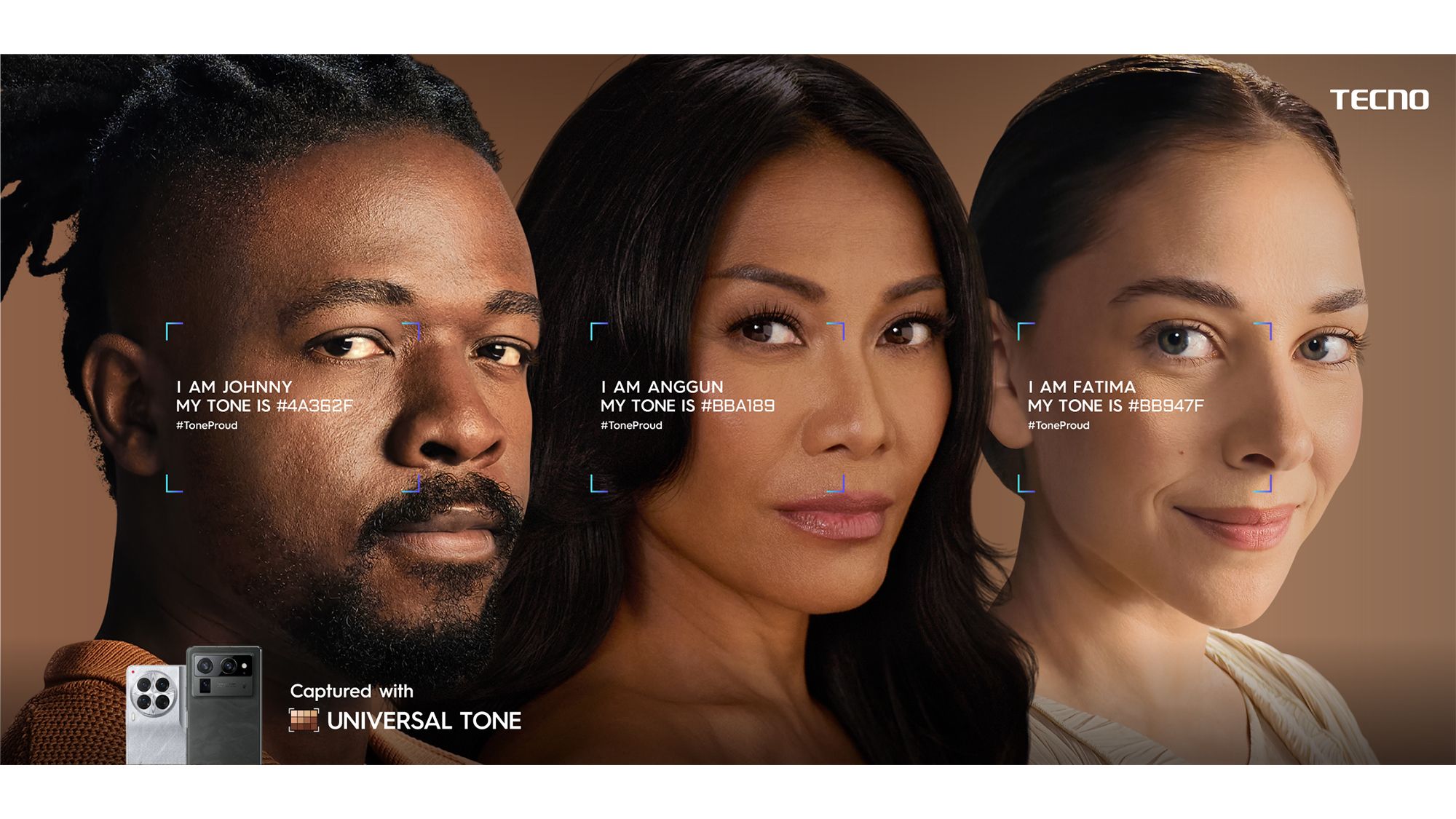
That’s not an accident of engineering but a legacy. The original color-calibration cards that shaped photographic film in the twentieth century were built around a narrow set of reference tones, largely lighter ones. Everything downstream, from chemical film stock to the digital sensors and, eventually, the AI models that now process our photos, inherited that same narrow starting point.
Wood grain, dark chocolate, and, most importantly, darker human skin has all suffered the same fate: flattened detail, muddy shadows, colour casts that don’t match what the eye actually sees. It’s a bias baked so deep into the tools that most people never think to question it. They just assume their photos “don’t turn out right” in certain lighting, without realizing the camera was never calibrated to represent them accurately in the first place.
This is where TECNO’s Universal Tone system deserves serious attention, and not just as a marketing line.
Rather than accept the industry-standard colour reference, a card with 24 patches that has quietly underpinned most of photographic history, TECNO built its own, expanding it to 372 distinct skin-tone patches. That’s not a cosmetic upgrade. It’s a fundamentally larger dataset, one built specifically to capture the chromatic range of human skin across markets that mainstream camera calibration simply never prioritized: Sub-Saharan Africa, South and Southeast Asia, the Middle East, and Eastern Europe. For a brand whose core markets are Africa and India, this isn’t a side project. It’s a direct response to what its own customers have been saying for years.

What makes the approach credible is the method behind it, not just the number. TECNO didn’t stop at expanding a colour chart. It paired that expanded reference with a Multi-Skin Tone Colour Restoration Engine, a system built to correct the two failure modes that have plagued darker skin tones specifically: over-darkening in low light, and unnatural reddish or ashy casts under artificial lighting. Alongside that sits a local tuning engine, which factors in regional lighting conditions, climate, and even colour temperature preferences that differ from one market to another. A portrait taken in Nairobi’s midday sun and one taken under Lagos evening light aren’t the same imaging problem, and treating them as if they were is exactly how bias creeps back in even after a company claims to have “fixed” it.
That distinction matters because the deeper issue with imaging AI was never really about hardware. It’s about data. When a model is trained overwhelmingly on lighter-skinned faces, in well-lit, evenly toned conditions, it doesn’t just perform worse on darker skin, it doesn’t know what accurate even looks like for that skin tone. It fills the gap with assumptions borrowed from the majority of its training examples. That’s how you end up with cameras that boost exposure until dark skin looks grey, or apply skin-smoothing algorithms that erase texture and depth. TECNO’s answer, building a dataset intentionally weighted toward the tones that were historically excluded, and testing it across hundreds of real-world lighting scenarios rather than a lab-controlled ideal, is a genuinely structural fix rather than a filter slapped on top of the same broken foundation.
None of this happens in a vacuum, either. TECNO’s broader push into Kenya’s connected device market, from AI-enabled tablets to smart home ecosystems, reflects a company betting its future growth on markets the rest of the industry has treated as secondary for too long. A camera that finally renders Kenyan, Nigerian, or Indian faces the way they actually look isn’t a footnote to that strategy. It’s the proof of whether the company understands its own customers at all.
Representation in imaging isn’t a luxury feature or a diversity talking point tacked onto a spec sheet. For the better part of a century, an entire category of people were told, implicitly, through blown-out shadows and muddy skin tones, that the technology simply wasn’t built with them in mind. Fixing that requires more than a software patch. It requires rebuilding the dataset from the ground up, and that is precisely the harder, less glamorous work TECNO appears to be doing.