Chadema Chairman Tundu Lissu has told the High Court that the prosecution has failed to prove that the Government of the United Republic of Tanzania was threatened by the words he allegedly uttered, saying the absence of that evidence leads to only one conclusion — that the Government was not threatened.
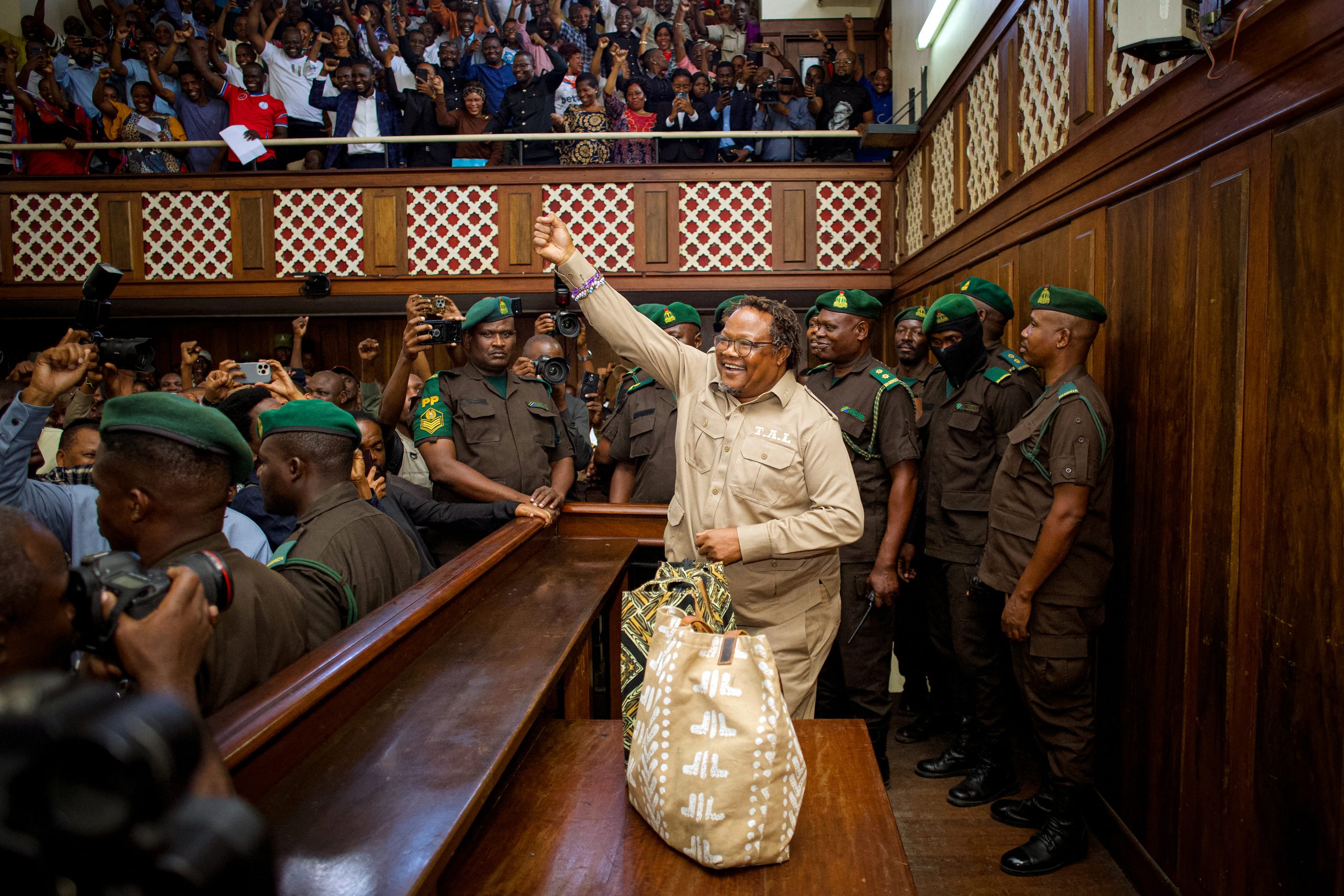
The trial comes after Tanzania weathered international criticism over its handling of protests around national polls last year, in which thousands were killed according to the opposition and rights activists. (Photo by AFP)
Lissu made the submission today, Friday September 25, 2026, as he continued his final submissions in the treason case facing him. He also spent part of his time discussing the history of the treason law and the Court of Appeal’s position on whether words alone can constitute the offence.
On this argument, Lissu said the question of whether the Government was threatened must be considered together with the intent alleged by the prosecution under Section 39(2) of the Penal Code.
He argued that if the prosecution claims his words were intended to threaten the Government, it should have indicated in the charge sheet and proved with evidence the result of that intent, including whether the Government of the United Republic was actually threatened.
According to Lissu, no part of the charge sheet explains how the Government was threatened, nor is there evidence from any Government leader or authority who appeared in court to prove that the Government was threatened by those statements.
He said he had requested that some Government leaders be called as witnesses, including President Samia Suluhu Hassan, former Vice President Philip Mpango and former Prime Minister Kassim Majaliwa, but the Court rejected the requests.
Lissu said even after the Court allowed him to summon the Chief of Defence Forces, the Inspector General of Police and the Director of Criminal Investigations, none of them gave evidence proving that the Government was threatened.
He also mentioned the Director of Criminal Investigations, Commissioner of Police Ramadhani Kingai, who appeared but did not give evidence in his favour.
On that basis, Lissu said the burden of proof lay with the prosecution, not the defence.
“On the record, not a single person came to prove whether the Government was threatened. If the Government was not threatened, it means I have no case,” he said.
Lissu continued that the defence had no obligation to prove that the Government was not threatened; that responsibility lay with the prosecution to prove all elements of the alleged offence.
He said no evidence was presented in court to show that Government leaders or the Government itself felt threatened by the statements he allegedly made.
Concluding his argument, Lissu said the answer to the question of whether the Government was threatened should be in the negative.
“The answer to this question is: The Government was not threatened.”
The argument followed Lissu’s earlier submission that words alone cannot constitute treason, in which he cited the case of Hatibu Gandhi and others and the history of the treason law.
In making that argument, he used the dock to trace the history of the law, referring to its origin in the English legal system and how it was incorporated into the laws of Tanganyika.
He said the history of treason law in Tanzania is important in interpreting Section 39 of the Penal Code, claiming that Tanzania’s treason provisions originated from the English legal system where, according to his argument, provisions relating to treason by words were removed.
On that basis, Lissu said the prosecution should not attempt to introduce into Tanzanian law the concept of “treason by words” which, he claims, has never been part of that law.
Referring to the case of Hatibu Gandhi and others, Lissu said the Court of Appeal emphasized the importance of an overt act in proving treason.
In his view, that decision shows that statements or words alone cannot be the basis for convicting a person of treason without an act that satisfies the legal requirements.
“Do spoken words constitute the offence of treason?” Lissu questioned, saying this is one of the issues the Court must decide in his case.
Lissu said the prosecution wants the Court to accept that the statements he allegedly made on April 3, 2025, are sufficient to constitute treason, which he described as an attempt to introduce a new interpretation into the law.
“My advice to you, honourable judges, when you make your decision with an understanding of this history, do not accept their invitation to import into our treason law things that have never existed at all and matters on which the Court of Appeal of Tanzania has already taken a clear position,” he said.
Lissu also linked that argument to the publication of the words he allegedly uttered through Jambo TV, saying the prosecution must prove with evidence that he is the one who published the video.
He said prosecution witnesses who testified about the publication gave conflicting accounts of who uploaded the video to Jambo TV.
Regarding the Republic’s third witness, Lissu said the witness admitted he found the video on Jambo TV’s YouTube channel but did not establish in his investigation who uploaded it.
Regarding the Republic’s 16th witness, he said the witness claimed Lissu had published the video, but under cross-examination admitted he was not sure whether Lissu was an employee of Jambo TV or whether he had access to its YouTube account.
Lissu said those contradictions should be considered in determining whether the prosecution has proved the elements of the offence he is facing.
The case has been adjourned to Monday, September 28, 2026, at 9 a.m., when Lissu is expected to conclude his final submissions to pave the way for the Republic.
Lissu is facing a treason charge in Criminal Case No. 19605/2025 at the High Court of Tanzania, accused of committing an offence contrary to Section 39(2)(d) of the Penal Code through statements allegedly made on April 3, 2025.
He was first arrested on April 9, 2025, in Mbinga town, Ruvuma Region, and transported the same night to Dar es Salaam. On April 10, 2025, he was arraigned for the first time at the Kisutu Resident Magistrate’s Court