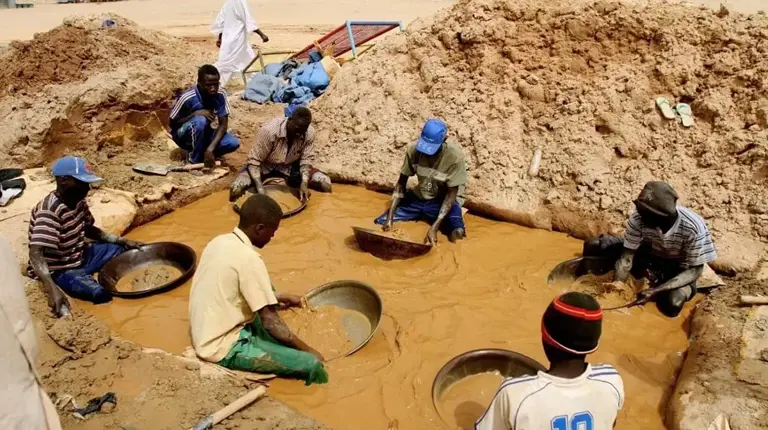
At least 72 workers were killed by airstrikes on a gold mine on the Sudan-Egypt border, a Sudanese rights group said on Sunday, after survivors described scenes of chaos in the mountainous region.
The Emergency Lawyers rights organisation accused the Egyptian air force of carrying out the attack. AFP could not independently confirm the account and Egypt has issued no official comment.
The attack on Saturday was the second this year on Jabal al-Uqaydat, after airstrikes, reportedly by Egypt, killed 23 workers in the informal gold mining site in June.
The Egyptian army did not claim the strikes but said at the time that it had conducted a “large-scale operation” against illegal gold mining within its borders.
The border between Sudan and Egypt is disputed, with both countries claiming the resource-rich Halayeb triangle. Cairo is however a key ally of Sudan’s army, at war with the paramilitary Rapid Support Forces.
The attack on Saturday “resulted in the deaths of 72 civilian miners, according to preliminary information, while efforts to document and verify the casualty toll are ongoing,” said the Emergency Lawyers, which documents atrocities in Sudan’s war.
Two survivors described to AFP their harrowing escape from the mine.
Miner Abdelaziz Youssef said a jet appeared overhead at around 8:00 am (0600 GMT) on Saturday and “struck five times, many people were killed”.
“We ran up the mountain terrified of another strike,” he told AFP.
Another survivor, Sharaf Ali, said there were thousands of people working at the remote site when it was hit.
“After the airstrike people scattered, some people came to Al-Ansary market, others went in the other direction, that’s why no one knows how many exactly were killed,” he said from the gold market, just south of the Halayeb triangle.
Both survivors said they saw bodies on the ground as they fled, with many more feared trapped under the rubble, hours away from any urban centre.
– Gold rush –
Since April 2023, the conflict has killed more than 200,000 people and created a deep humanitarian crisis that has pushed many into the dangerous gold mining industry, which fuels both sides’ war efforts.
The rugged mountainous area, home to bountiful mineral deposits, stretches for hundreds of kilometres and includes the disputed Halayeb triangle.
The Emergency Lawyers said the attack occurred within Sudanese territory.
“The repeated attacks on the gold- and mineral-rich border regions reflect a desire by Egyptian authorities to expand and assert control over Sudan’s natural resources,” it said.
The Egyptian army in June said it carried out its operation “within Egyptian territory”.
It said 223 people were detained, including 136 foreign nationals, and announced a campaign to counter “illegal gold mining and arms smuggling” in the area.
Despite backing Sudan’s army chief Abdel Fattah al-Burhan, Egypt considers the war at its border — which stretches 1,200 kilometres from the Red Sea to Libya — a major threat to its security.
East of the Nile River, the porous border has for years been a thriving conduit for gold, illicit trade and human trafficking, which Egypt has tried to stem including by using mass deportations.