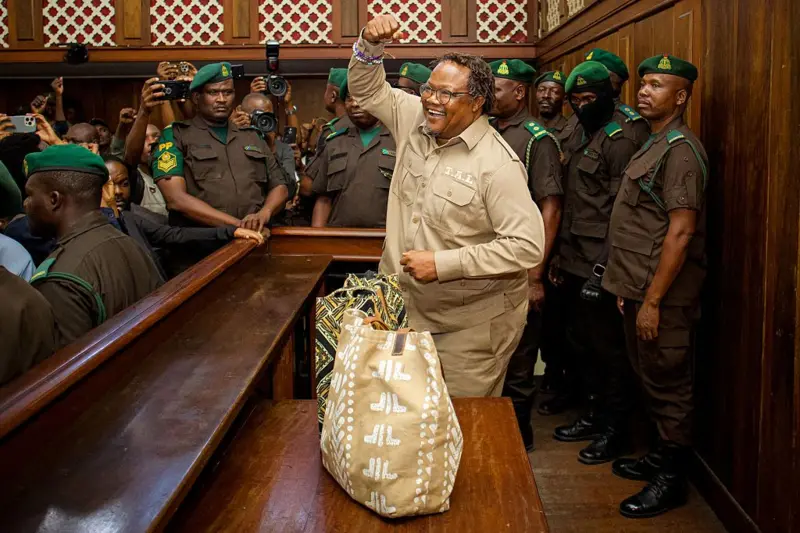
In the High Court of Tanzania, in the Treason Case of 2025, Tundu Lissu, the accused and Chairman of CHADEMA, today, 23rd Sep 2026, presented his final submissions and closing arguments before a full bench of three Justices presided over by the Honourable Justice Dastan Ndunguru.
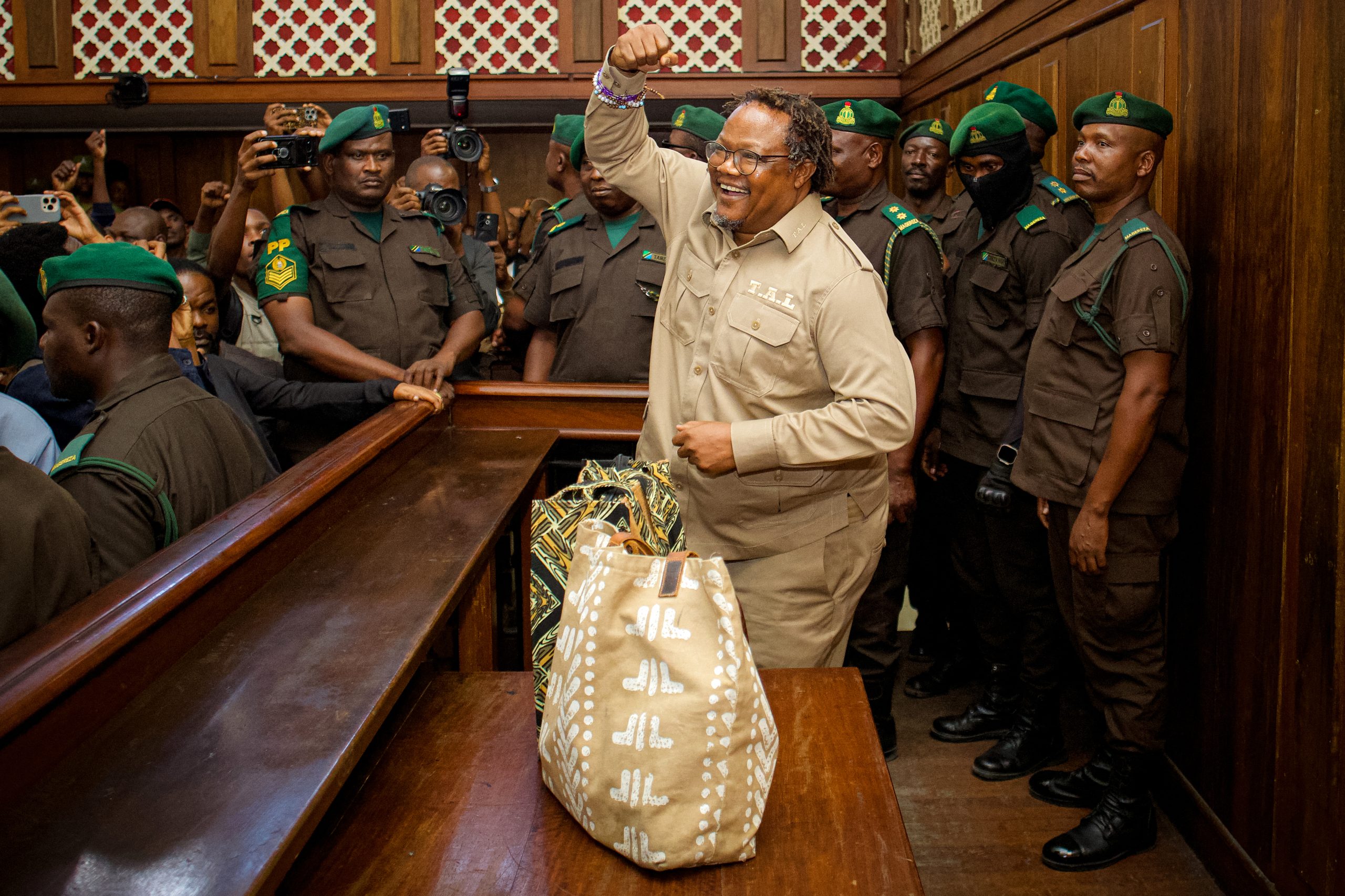
The trial comes after Tanzania weathered international criticism over its handling of protests around national polls last year, in which thousands were killed according to the opposition and rights activists. (Photo by AFP)
The defence submitted that the prosecution has failed to establish beyond reasonable doubt that the words attributed to the accused and uttered at various political meetings satisfy the essential legal ingredients of the offence of treason as provided under Section 39(2)(d) of the Penal Code.
On procedural history, the defence recounted that the accused was arrested at Mbinga in Ruvuma Region on the evening of the 9th April, 2025 after addressing a political rally organized by Chadema and was thereafter transported during the night to Dar es Salaam where he was arraigned before the Kisutu Resident Magistrate’s Court on the 10th April, 2025 and the charge sheet containing two counts including treason was read to him. It was further stated that the matter was committed to the High Court following an information filed by the Director of Public Prosecutions on the 12th August, 2025.
According to the information, the prosecution alleges that the accused, while within the United Republic of Tanzania, formed an intention to incite the public and to facilitate the prevention of the general election of 2025 with intent to threaten the government and manifested that intention by words spoken and published, including statements concerning the prevention of the election, incitement to insurrection and disruption of the electoral process.
The additional facts allege that the accused convened the meeting of CHADEMA aspirants held on the 3rd April, 2025, invited journalists from Mwananchi Communication Limited, Jambo TV and Clouds Media to cover the proceedings and that his utterances incited persons in Arusha, Kilimanjaro, Ruvuma, Dar es Salaam and Mbeya to conspire to prevent the general election by force.
The defence position, as presented, is that the accused has never denied the actus reus of uttering the impugned words, which were spoken not on a single occasion but across various regions, including Njombe, Lindi, Mbeya and Mtwara. The defence case therefore turns on a pure question of law as to whether mere political speech so admitted can in law constitute the offence of treason.
In this regard the accused prayed that the Court determines whether the prosecution has proved that he convened the meeting of the 3rd April, 2025, whether it has proved that he invited the journalists, whether the impugned words constitute any criminal offence and if so whether such offence amounts to treason, whether words per se can constitute an overt act for purposes of treason, whether publication via a third party platform namely the YouTube channel of Jambo TV is attributable to the accused within the legal definition of publishing, whether the Government of the United Republic of Tanzania was in fact threatened or intimidated as a result of those words, and whether the prosecution has discharged its burden to the standard required by law and what verdict should consequently be entered.
On the principles of criminal law, the accused submitted that penal statutes imposing severe punishment must be subject to strict construction in favour of the accused, that the burden of proof remains throughout the trial upon the prosecution, that evidence must be assessed holistically and not by selective reference to isolated fragments, and that a conviction must be founded upon the strength of the prosecution evidence and not upon any perceived weakness in the defence case.
On precedent, the defence argued that this is only the third prosecution ever instituted under Section 39(2)(d), the two prior authorities being Republic versus Grey Likukungu and Others of 1970 and Republic versus Khatibu Ghandi and Others of 1983, both of which concerned allegations of overthrowing the government, whereas the present case concerns an allegation of threatening the government, and that the judgment of this Court will therefore establish a binding precedent on the interpretation of threatening the government under treason law.
On the requirement of an overt act, the defence contended that the prosecution is duty bound to prove a manifest overt act and that mere words cannot satisfy that requirement unless the words themselves describe or direct the commission of acts.
In evaluating the evidence, the defence submitted that none of the seventeen prosecution witnesses adduced direct or documentary evidence establishing the manner in which the meeting of the 3rd April, 2025 was convened nor identifying the accused as the convenor, while defence witnesses, including John Mnyika, who is Secretary General of Chadema, together with Amani Golugwa and Brenda Rupia, testified that the said meeting was convened and organized by the Chadema Secretariat upon the direction of Mr. Mnyika. With respect to the invitation of journalists, the defence noted that the additional facts were silent as to who issued the invitations and that it was only later that the first prosecution witness, Assistant Commissioner of Police George Bagemu, testified that the accused invited journalists so that his speech could be heard by the public at large, a testimony said to have been corroborated by the second prosecution witness, Inspector John Kahaya, an allegation which the defence contends is untrue and unsupported by documentary proof.
The hearing is continuing, and the prosecution is expected to present its reply submissions.