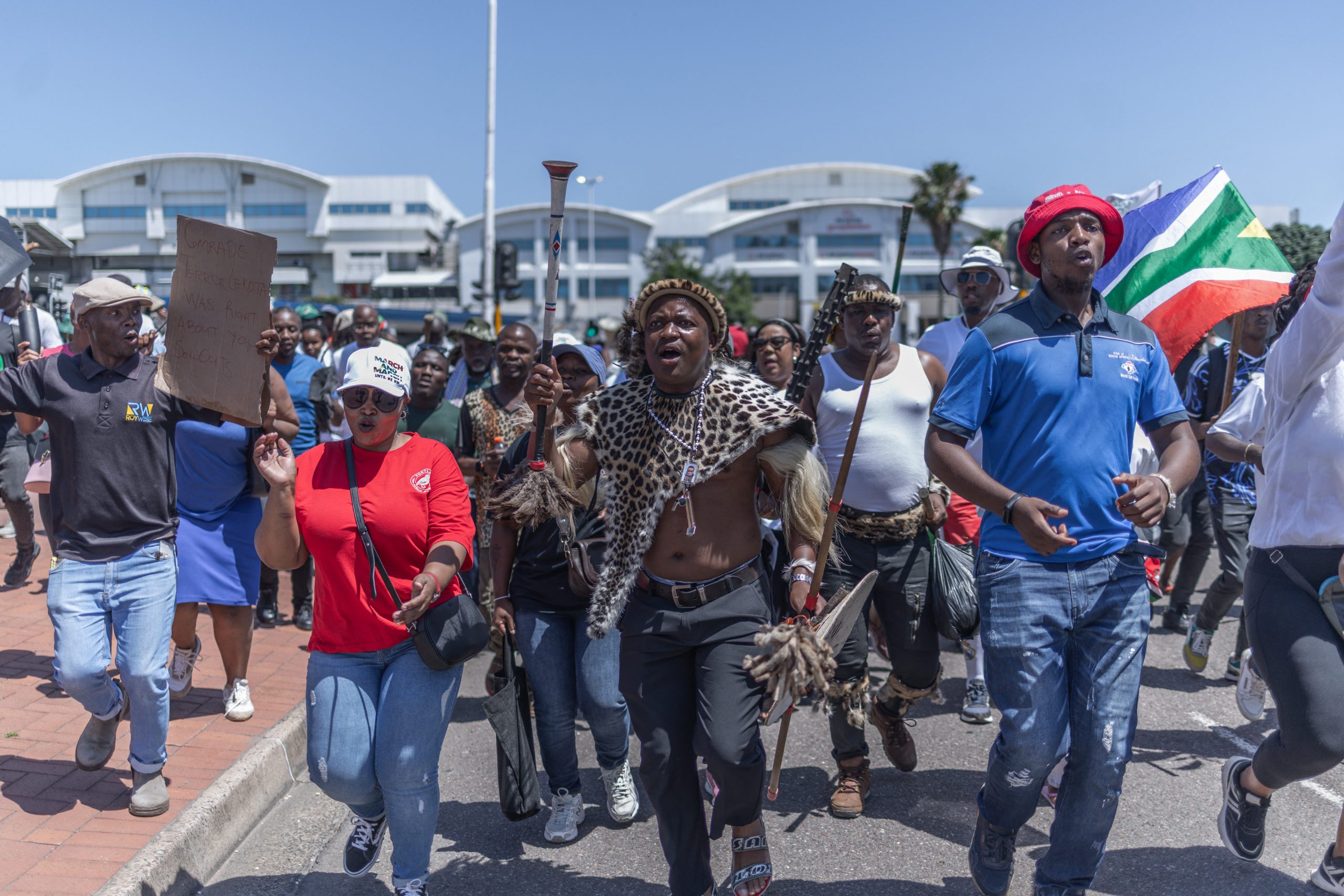
Hundreds of protesters brandishing placards rallied outside a court in South Africa’s coastal city of Durban on Friday as the government sought to halt anti-migrant demonstrations that turned deadly last week, leaving one person dead.
Durban, the Zulu heartland, has emerged as a focal point of anti-migrant agitation led by the March and March movement, which has organised demonstrations against undocumented foreigners across the country for months.
Some demonstrations have turned violent, including last week when a mob of about 50 people beat a foreign national to death, prompting President Cyril Ramaphosa to deploy more than 500 soldiers to support the police.
Protesters sang and chanted outside the court, waving placards and sticks as police officers stood watch, footage broadcast by South African media showed.
Supporters of several political parties, including the centre-right ActionSA and the uMkhonto weSizwe (MK) party led by former president Jacob Zuma, also turned out in solidarity, Newzroom Afrika television reported.
“The agenda is to try and silence the people,” said March and March legal representative Xolani Zuma.
“The real problem are illegal immigrants who are here in the country and terrorising people,” he told reporters.
The court action was brought by acting Police Minister Firoz Cachalia, who is seeking to stop the demonstrations on the grounds that they threaten public order and the safety of foreign nationals.
He cited police intelligence about an alleged plot to set fire to the Home Affairs Refugee Reception Centre in Berea, an inner-city suburb of Durban where asylum seekers go to seek documentation.
The unrest has been fuelled by misinformation about a July Constitutional Court ruling that asylum seekers cannot be denied access to South Africa’s asylum system solely on procedural grounds, according to the police.
Counsel for the police told the court on Friday that the situation in Durban had “degenerated into lawlessness” that reactive policing could no longer contain.
More than 400 police officers had been deployed, but this had “proved structurally unable to stem the widespread violence”, they said.
The court battle comes days before local elections on November 4, with lawyers warning that police are already stretched thin ahead of the vote.